


Policy Empowers Innovation, Testing Provides Safeguards for Progress—An Interpretation of the “Catalog of High-End Medical Devices Subject to Priority Review (2025 Edition)” and Supporting Industry-Specific Measures
Release date:
2026-02-13 15:01

On December 26, 2025, the National Medical Products Administration officially released the “Catalog of High-End Medical Devices Subject to Priority Review (2025 Edition).” This landmark policy is driven by clinical needs and establishes a “green channel” for the registration and review of eight categories of high-end medical devices, marking the entry of China’s high-end medical equipment industry into a new phase of targeted support and high-quality development. At the same time, it sets higher standards across the entire R&D, testing, and validation value chain: while shortening the time-to-market, it remains imperative to uphold the fundamental principles of safety, efficacy, and controllable quality. Professional testing and validation services are therefore pivotal in bridging the gap between innovative R&D and the effective implementation of regulatory policies.
This edition of the Catalogue represents a concrete measure to implement Document No. 53 of 2024 issued by the General Office of the State Council. In accordance with the Measures for the Registration and Filing of Medical Devices, it specifies that priority review will be granted to eight categories of products, including boron neutron capture therapy systems, ultra-high-field magnetic resonance imaging equipment, implantable brain–machine interfaces, and minimally invasive interventional devices. The key benefits lie in shortening the review cycle, allocating more resources, and enhancing coordination between clinical evaluation and registration. As a result, the average review period for innovative devices is expected to be reduced from 18 months to no more than 12 months. However, the policy makes it clear that “priority does not mean lowering standards”; the criteria for assessing safety and effectiveness remain unchanged. Therefore, companies must conduct rigorous, scientifically sound testing and validation to ensure robust data quality if they are to fully benefit from this policy.
Based on the products included in the Catalog, Minimally invasive interventional devices occupy a pivotal position; transcatheter tricuspid valve replacement/repair systems and minimally invasive glaucoma drainage implants, among others, are critical solutions to the clinical challenges faced by elderly and high-risk patients and represent key areas for domestic substitution. The R&D and validation of such devices rely heavily on high-fidelity simulation test models: before clinical deployment, these devices must undergo repeated simulations of the human physiological environment to assess their performance and safety under realistic anatomical conditions and hemodynamic settings. This directly determines the quality of R&D and the success rate of regulatory submissions, thereby creating an urgent need for specialized medical simulation testing services.
In this field, Xi’an Dewei Medical has become a vital pillar supporting the R&D and validation efforts of medical device companies. As a provider specializing in high-end medical testing equipment, as well as tailored testing services and solutions, Dewei Medical boasts extensive experience and outstanding technical expertise in medical simulation, test equipment development, and software engineering. The company is particularly adept at delivering comprehensive testing solutions for minimally invasive interventional medical device firms and cutting-edge research-oriented medical laboratories, precisely aligning with the R&D and testing requirements for devices listed in the Catalogue and thereby providing robust supporting infrastructure for the effective implementation of relevant policies.


DeWei Medical’s vascular model is equipped with an intelligent blood-flow platform—providing precise hemodynamic simulation.
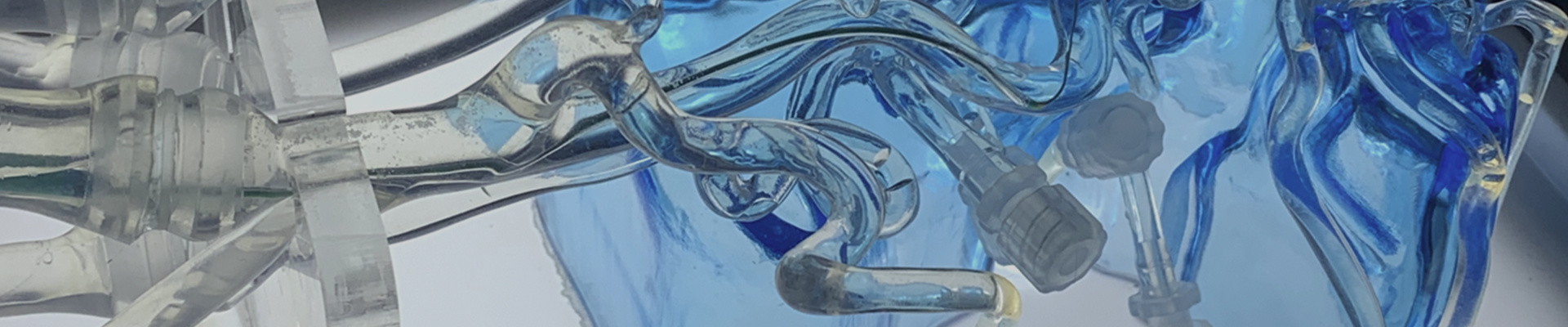
The core competitive advantage of DeWei Medical lies in the research, development, and application of simulation models: The simulation model faithfully replicates human anatomy on a one-to-one scale, with vascular models fabricated from a proprietary, highly transparent soft silicone material that accurately reproduces hemodynamic flow and vascular physiological characteristics. This innovative approach overcomes the limitations of traditional materials, creating a testing environment that more closely mirrors real-world human conditions. In conjunction with a comprehensive suite of testing equipment—including sensors and flow monitors—the model enables precise measurement of critical performance metrics for minimally invasive interventional devices, such as pushability and flexibility, while capturing comprehensive operational data. These data provide a robust scientific foundation for product design optimization and the refinement of regulatory submission documentation.
The overarching policy direction of the Catalog is to break through bottlenecks in “chokehold” areas, accelerate domestic substitution and supply-chain security, and encourage enterprises to focus on achieving independent control over core technologies. Currently, China’s medical-device-model market continues to face challenges such as heavy reliance on imported high-end materials and significant technical barriers to high-fidelity simulation. DeWei Medical’s independent R&D not only fills a critical gap in domestic high-fidelity testing for minimally invasive interventional devices, but its proprietary soft-silicone material also eliminates dependence on imports. This aligns closely with national policy priorities and provides robust support for domestic firms in reducing R&D costs and enhancing testing efficiency.
For medical device companies, seizing policy opportunities requires not only identifying the right R&D focus but also placing great emphasis on end-to-end testing and validation. DeWei Medical’s specialized solutions build an efficient, end-to-end bridge for enterprises spanning R&D, testing, and regulatory submission: its simulation models can replicate complex human physiological scenarios, enabling comprehensive preclinical performance testing and risk assessment; its service model covers the entire development process, eliminating the need for companies to establish separate test platforms and significantly reducing R&D and testing costs—making it particularly well-suited for innovative firms focused on core device development.


Application Examples of DeWei Medical Vascular Models
Policy empowerment and technological support. The implementation of the Catalogue has injected strong momentum into the high-end medical device industry, driving coordinated upgrades across the entire value chain. Under the guidance of these policies, an increasing number of companies are focusing on innovation and breaking through bottlenecks, while DeWei Medical will leverage its cutting-edge expertise and services to provide robust support for innovation in medical devices, accelerating the market launch and clinical adoption of more domestically developed high-end devices. In alignment with national policy priorities, the company is committed to enhancing capabilities in the treatment of critical illnesses and ensuring the security of the medical supply chain.
In the future, as policies are dynamically adjusted and the industry continues to develop, the R&D and testing requirements for high-end medical devices will continue to rise. DeWei Medical will continue to deepen its expertise in medical simulation and testing, iteratively enhance its technical services, and optimize model performance, thereby providing precise and efficient testing support to more enterprises and research institutions. Working closely with industry peers and leveraging favorable policy initiatives, we will drive the high-quality development of China’s high-end medical equipment industry and ensure that the fruits of innovation benefit a broad patient population.
Keywords:
3D printing,Medical devices,High-end medical devices,National Medical Products Administration,Medical Device Technical Review Center,Minimally Invasive Intervention,Neurointerventional Vascular Model,Medical Device R&D and Testing,Silicone vascular model
Other news
Request a quote
*Please keep your phone accessible—we'll reach out to you within 24 hours.
PARTNERSHIP
Partnership

Contact us
Address: Wangzuo Qujiang, 3269 Yanxiang Road, Yanta District, Xi'an City
Pre-sales Consultation
Request a quote


