


Research and Development and External Validation of a Mixed-Reality Intracranial Aneurysm Clipping Simulator—Focusing on the Medical and Device R&D Value of 3D-Printed Models
Release date:
2026-03-18 16:43
Abstract
Intracranial aneurysm surgery is one of the most technically challenging and high-risk subspecialties in neurosurgery. With the increasing prevalence of endovascular interventions, the number of craniotomy cases has steadily declined, and those that remain are predominantly complex and high-risk. Consequently, both precision clinical diagnosis and treatment, as well as the development of supporting medical devices, have encountered significant bottlenecks, underscoring the urgent need for highly realistic simulation tools to overcome these limitations. Building on the MEDUSA project, this study has developed and externally validated a personalized mixed-reality intracranial aneurysm clipping simulator. The core innovation lies in using 3D printing to construct a physical model base, integrating virtual vascular and aneurysm modules, pairing them with clinically standard surgical instruments, and incorporating hemodynamic simulation capabilities. This integrated platform enables optimization of diagnostic and therapeutic strategies for complex cases and facilitates closed-loop testing of device performance.
The simulator employs a 1:1 scale, 3D-printed rigid cranial model paired with 3D-printed, mold-cast biomimetic silicone cerebral lobes, which are securely mounted on a standard neurosurgical head frame to form the physical platform. High-precision optical tracking technology enables real-time synchronization between actual surgical instruments and the virtual environment. The 3D-printed skull accurately replicates individual anatomical structures, allows flexible adjustment of the surgical bone window size, and faithfully reproduces the spatial constraints of a real surgical field. The biomimetic cerebral lobes closely match the mechanical properties of human brain tissue, providing realistic physical feedback during instrument manipulation. Upon completion of the procedure, the system automatically simulates hemodynamics, objectively assessing the efficacy of clipping and vascular patency, thereby providing quantitative evidence for treatment planning and instrument performance validation.
This study conducted a joint evaluation at two international academic conferences, performing external validation with 40 neurosurgeons and using a 5-point Likert scale to assess core performance metrics. The results showed that the simulator received overall scores ranging from 3.13 to 4.25, with particularly high ratings for blood-flow simulation (4.25), the fit of the 3D-printed model (4.20), and the application value of instrument development (4.20). All participants acknowledged the 3D-printed model’s pivotal role in supporting the system, confirming that the platform can be widely applied to the diagnosis and treatment of complex aneurysms as well as to the research and development and testing of surgical instruments. By fully leveraging the advantages of 3D printing technology, this mixed-reality simulator offers an efficient and feasible new solution for cerebrovascular diagnosis and treatment and for innovation in medical devices.
Introduction
The diagnosis and treatment of intracranial aneurysms demand extremely high anatomical precision and device compatibility. Influenced by the ISAT trial, global clinical practice has increasingly shifted toward endovascular intervention, with craniotomy reserved for only the most challenging and complex cases. This shift has not only heightened the technical difficulty of clinical care but has also disrupted the development and testing timelines for supporting surgical instruments. Traditional instrument evaluation relies on clinical cases and ex vivo specimens, which suffer from poor anatomical fidelity, lack of reproducibility, and difficulties in quantifying data—shortcomings that fail to meet the R&D needs of advanced minimally invasive devices.
Against this backdrop, 3D printing technology, with its advantages of personalized customization, high anatomical fidelity, and standardized replication, has emerged as a core enabling technology in the medical field and for medical-device R&D, fundamentally transforming traditional ex vivo testing paradigms. Industry players such as Dewei Medical leverage 3D printing, hemodynamic simulation, and biomimetic design to develop 1:1 scale, highly bioinspired cerebral vascular models and standardized ex vivo testing platforms, integrated with specialized monitoring equipment, thereby providing robust support for interventional-device R&D, performance validation, and risk management. This study deeply integrates 3D printing with mixed-reality technologies to develop a dedicated simulator, with a primary focus on validating the core value of 3D-printed models in clinical diagnosis and treatment as well as in medical-device development.
Materials and Methods
Simulator Research and Development Design
From 2019 to 2024, this simulator underwent iterative optimization based on the prototype, with a 3D-printed physical model at its core. It integrates optical tracking, virtual simulation, and blood-flow simulation modules to fully replicate the clinical operating-room environment throughout the entire procedure. The core physical platform is an individualized cranial model 3D-printed from medical-grade materials, which accurately reproduces the anatomical features of the skull, including a preconfigured pterional approach bone window that can be flexibly adjusted. Inside, silicone brain lobes are custom-molded using 3D-printed molds to perfectly replicate the mechanical properties of brain tissue, constrain instrument trajectories, and recreate the spatial constraints of real surgical environments.
The system utilizes clinically authentic aneurysm clamps—compatible with over 50 models—and integrates reflective marker points on the instruments. Six infrared cameras enable sub-millimeter spatial tracking with 0.1-mm precision, thereby achieving spatiotemporal synchronization among 3D-printed models, real instruments, and virtual modules. The virtual module is based on multi-modal imaging data—including patient CT, MRI, and DSA—and completes individualized 3D reconstruction within 15 minutes. The aneurysm wall is modeled using finite-element analysis to provide real-time deformation feedback, while the blood-flow simulation module can rapidly identify residual aneurysm tissue, vascular stenosis, and other issues, enabling an objective assessment of instrument manipulation and clamping performance.

External Validation Plan
The validation was conducted at two international neurosurgical conferences held in Tübingen, Germany, and Marseille, France, in 2024, enrolling a total of 40 neurosurgeons with 1 to 38 years of clinical experience spanning various levels of practical expertise. A 32-item, 5-point Likert scale was used to comprehensively assess the fidelity of 3D-printed models, system compatibility, instrument interoperability, and research-and-development application value, supplemented by statistical analyses to examine differences in the results. The study received ethical approval and complies with relevant research guidelines.

Result
A total of 40 participants completed all assessments, with overall scores ranging from 3.13 to 4.25. The synergistic performance of the 3D-printed physical module and the virtual module was consistently endorsed. Notably, blood-flow simulation accuracy and the synchronization between virtual and physical models received the highest scores (4.25), while the anatomical fidelity of the 3D-printed models and the system’s utility in instrument testing both scored 4.20. Scores for the mechanical interaction between instruments and bio-inspired tissues ranged from 3.13 to 3.93. Senior experts applied more stringent evaluation criteria, and the intergroup differences were statistically significant, further confirming that the system’s high-fidelity simulation meets professional testing standards.
All participants agreed that 3D-printed models can effectively replace traditional cadaveric specimens, accurately replicating real anatomical constraints and the operative environment; more than 90% of participants believed that, Leveraging the advantages of 3D printing technology, this system can be directly applied to the design optimization, in vitro performance testing, and stability validation of novel surgical instruments such as aneurysm clips, demonstrating significant potential for industrial implementation.
Discussion
The core breakthrough of this study is the establishment of The Irreplaceable Value of 3D-Printed Models in Neurosurgical Diagnosis and Treatment and Medical Device Development Compared with traditional methods such as purely virtual simulations and ex vivo specimens, 3D printing technology offers three core advantages: first, individualized, precision replication—custom-made models are created at a 1:1 scale based on patient imaging, eliminating test errors arising from anatomical variability and ensuring close alignment with real-world clinical and device-use scenarios; second, highly biomimetic mechanical properties—rigid cranial bones paired with soft, bio-inspired brain lobes accurately replicate the resistance and spatial constraints encountered during actual device manipulation, providing a realistic environment for testing device mechanical performance and handling characteristics; and third, repeatable, standardized testing—models can be mass-produced without ethical constraints, supporting multiple comparative trials, thereby significantly shortening the device development cycle and reducing R&D risks.
This simulator is deeply integrated with the in vitro device-testing systems of companies such as Dewei Medical, both leveraging 3D printing as a core technology. While each focuses on distinct areas—clinical support for complex cases and specialized device testing, respectively—they jointly establish a comprehensive industry value chain spanning anatomical modeling, simulation testing, and iterative device development. This collaboration addresses the industry’s key pain points of “unrealistic test platforms and subjective performance evaluations,” thereby driving the R&D of cerebrovascular devices toward greater precision and standardization.


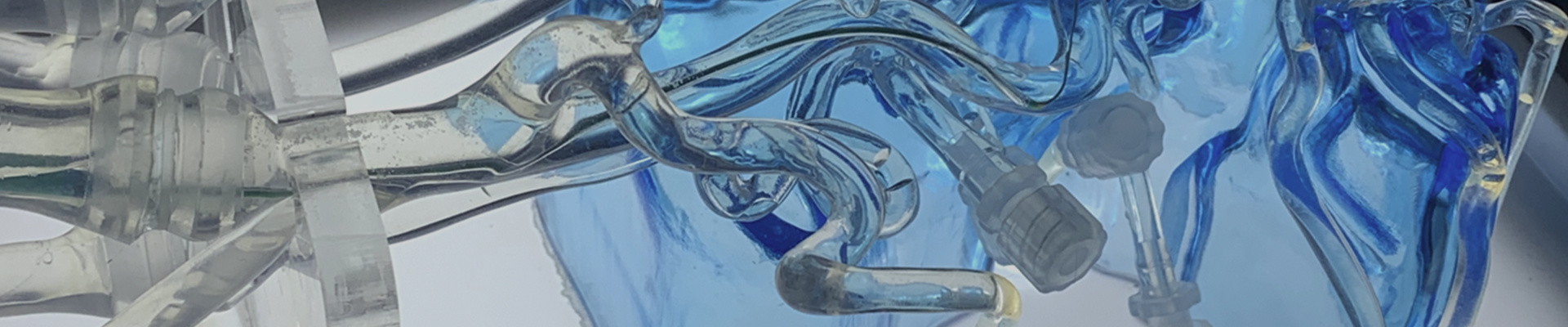
DeWei Medical Simulation Models—One-Piece Molding of Complex Vasculature, Precisely Simulating Human Vascular Anatomy and Functional Characteristics
There is still room for optimization in the current system. Currently, 3D-printed models do not yet encompass microscopic anatomical structures or the pathological features of complex aneurysms; future efforts will focus on expanding the range of model types, optimizing the accuracy of virtual–real registration, and further enhancing the suitability of these models for device testing. Nevertheless, the existing results have already amply demonstrated the core value of 3D printing technology.
Conclusion
This study successfully developed and validated a mixed-reality intracranial aneurysm clipping simulator, with 3D printing as its core enabling technology, to establish a highly realistic, patient-specific simulation testing platform. The results unequivocally demonstrate the pivotal role of 3D-printed models in the precise diagnosis and treatment of complex intracranial aneurysms, as well as in the research and development and performance evaluation of surgical instruments. Leveraging its advantages—such as precise anatomical replication, biomechanical biomimicry, and repeatable, standardized testing—3D printing has emerged as a cornerstone technology for complex anatomical modeling in medicine and for the R&D of medical devices, fundamentally overcoming the limitations of traditional testing methods and providing robust support for the innovative iteration of cerebrovascular diagnostic and therapeutic technologies and associated instrumentation. Looking ahead, as the technology continues to advance, 3D-printing–driven simulation systems will expand into additional specialty areas, driving the healthcare industry toward greater precision and intelligence while accelerating the translation of academic–industry–research outcomes into clinical practice.
To the Reader:
For access to the full research paper or for more up-to-date information on related topics, please contact our official website customer service, or follow “Xi’an Dewei” and “Dewei Medical” on WeChat, Douyin, Xiaohongshu, Bilibili, and other platforms. We offer professional consultation and customized services.
Keywords:
3D printing,Intracranial aneurysm clipping,Precision diagnosis and treatment,Medical devices,Neurointerventional Vascular Model,Silicone vascular model,Simulation model,Medical simulation,Medical device R&D
Other news
Request a quote
*Please keep your phone accessible—we'll reach out to you within 24 hours.
PARTNERSHIP
Partnership

Contact us
Address: Wangzuo Qujiang, 3269 Yanxiang Road, Yanta District, Xi'an City
Pre-sales Consultation
Request a quote


