

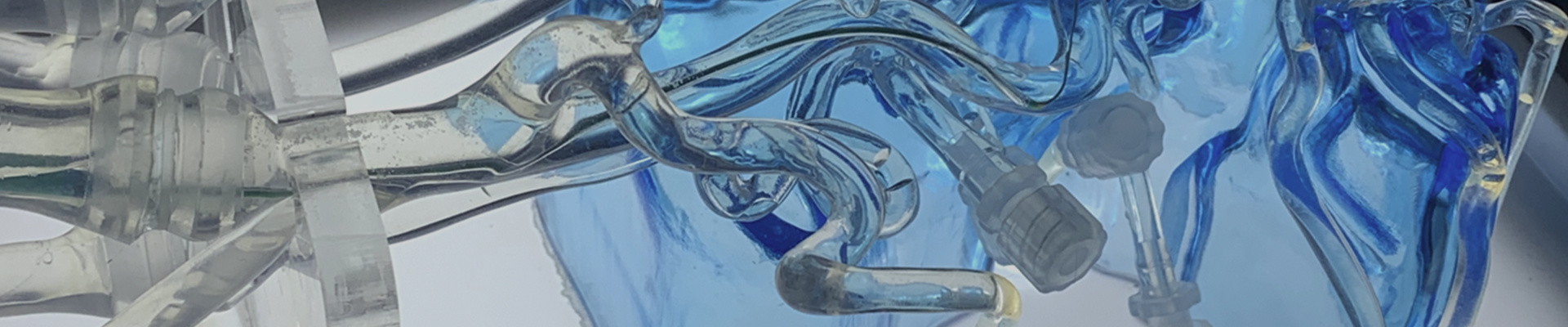

CTO Coronary Intervention Testing Model: A Precision R&D Platform for Full-Procedure Validation
Release date:
2026-03-27 16:32
Pain Point Focus: Challenges in Procedural Coverage and Pathway Replication for CTO Interventional Device Testing
Chronic Total Occlusion (CTO) coronary interventions represent the “Mount Everest” of coronary artery disease treatment, and the development of related devices has long been constrained by bottlenecks in core procedural validation scenarios.
On one hand, CTO recanalization relies on two core procedural approaches—antegrade and retrograde. The anatomical complexity of key collateral pathways, such as epicardial collaterals and septal branches, is extremely high. Existing models cannot accurately replicate the tortuous pathways and operational resistance of these vessels, resulting in antegrade and retrograde device testing that lacks real-world clinical relevance.
On the other hand, clinical PCI procedures must cover a variety of complex scenarios, including CTO lesions, bifurcation lesions, and stenotic balloon dilation lesions. Traditional models tend to focus on a single lesion type and cannot support full-process testing from guidewire passage, balloon dilation, to stent implantation. They also fail to meet the dual needs of multi-scenario validation during device development and market demonstration. These limitations directly lead to extended CTO device development cycles and verification results that deviate significantly from real clinical use.

Model Value Demonstration: Full-Procedure Testing Solution Implemented

Core Requirement Match: Providing Comprehensive Support for CTO Device Development
Based on the core design philosophy of “precise replication of procedural pathways + full lesion coverage,” this model effectively addresses the R&D challenges described above, providing full-procedure support for CTO device development and demonstration:


Guidewire Passage Through CTO Lesions Under High-Speed Imaging
- Supports Precise Verification of Antegrade and Retrograde Devices:
Using real clinical CTO cases as prototypes, the model accurately replicates core procedural pathways for antegrade and retrograde recanalization, including the tortuous courses of epicardial collaterals and the narrow diameters and angles of septal branches. It faithfully reproduces procedural resistance and tactile feedback, offering a high-fidelity testing environment for performance optimization of core devices such as guidewires and microcatheters.
- Covers Multi-Lesion Full-Procedure Testing:
Integrating common clinical lesion types—CTO lesions, bifurcation lesions, stenotic balloon dilation lesions—the model supports comprehensive PCI full-procedure testing. From guidewire penetration and balloon dilation to stent implantation and post-procedure evaluation, it accommodates real device operations without requiring repeated model setups, greatly enhancing R&D efficiency.
- Supports Both R&D Verification and Market Demonstration Needs:
Standardized lesion scenarios and full-procedure replication provide repeatable and quantifiable data for device development, helping optimize device performance. At the same time, it visually demonstrates device operation across different lesion types, clearly presenting key steps of the PCI procedure, and enhancing persuasive impact in marketing and sales demonstrations.
Keywords:
3D Printing,Minimally Invasive Intervention,Medical Device,Vascular Model,Silicone Vascular Model,Medical Simulation,Medical Device R&D Testing,CTO,Coronary Intervention,CTO Lesion,Chronic Total Occlusion,Antegrade and Retrograde Recanalization Devices,PCI,Chronic Total Occlusion,Percutaneous Coronary Intervention
Other news
Request a quote
*Please keep your phone accessible—we'll reach out to you within 24 hours.
PARTNERSHIP
Partnership

Contact us
Address: Wangzuo Qujiang, 3269 Yanxiang Road, Yanta District, Xi'an City
Pre-sales Consultation
Request a quote


