


A new breakthrough in carotid plaque phantoms: Testing model lesions with custom-tailored elastic modulus.
Release date:
2025-06-26
In the field of medical technology, even a micrometer-level error can determine the course of life. Atherosclerosis is a chronic condition that begins with lipid metabolism abnormalities, leading to inflammation within the vessel lumen, intimal necrosis, and fibrosis—ultimately resulting in plaque formation at specific sites along the arterial walls. Over decades of gradual progression, these plaques may trigger acute cardiovascular or cerebrovascular events such as stroke or myocardial infarction.
A new breakthrough in carotid plaque phantoms: Testing models customize the elastic modulus of lesion areas.
In the field of medical technology, every micrometer-level error can determine the course of life.
Atherosclerosis is a chronic condition that begins with lipid metabolism abnormalities, leading to inflammation within the vessel lumen, as well as endothelial necrosis and fibrosis—processes that ultimately result in plaque formation at specific sites in the arterial walls. Over decades of gradual progression, these plaques can trigger acute cardiovascular or cerebrovascular events such as stroke or myocardial infarction.
Among these processes, plaque formation results from the interplay of multiple physiological mechanisms, including lipoprotein deposition, recruitment of inflammatory cells, foam cell formation, apoptosis and necrosis, smooth muscle cell proliferation and matrix synthesis, calcification, angiogenesis, arterial remodeling, fibrous cap rupture, and thrombus formation. These processes are intricately interconnected, and their relative importance varies across the individual stages of plaque development, contributing to the unpredictable progression and heterogeneous morphology of plaques.
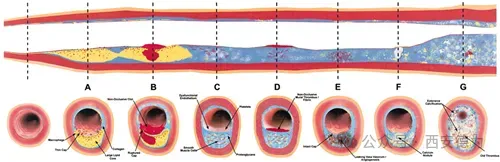
▲Atherosclerosis Disease Progression
- Technical and R&D Background
According to expert consensus, calcified lesions that are difficult to dilate exhibit the following characteristics:
IVUS: Calcification angle greater than 270° or significant calcified nodules;
OCT examination criteria: Maximum calcification angle >180°, lesion length >5 mm, maximum calcification thickness >0.5 mm.
Tests on calcified tissue dissected from carotid artery bifurcation plaques revealed that the Young’s modulus (E) of partially calcified fibrous tissue averaged 2.1 ± 5.4 MPa, with the maximum stiffness reaching 43 MPa.
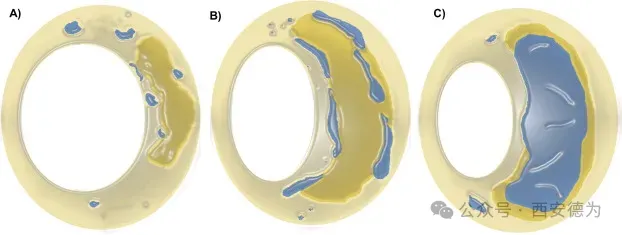
▲ Clinical imaging-based geometric classification of major calcifications: (A) Flecked/Fleck-like: Spot-like calcification spots (∼50 μm); (B) Linear Fragmented: Linear or broad single-focal calcifications (diameter >2 mm); and (C) Diffuse: Continuously calcified fragments (≥5 mm).
Therefore, developing a biomimetic model of carotid artery plaques is nothing short of "hellishly challenging": It requires precisely replicating the elasticity of human blood vessels, the mechanical properties of plaque components, and the dynamic response under blood flow impact. Traditional materials and manufacturing techniques produce models with high error rates, making them inadequate for the rigorous demands of device validation.
- DeWei Medical Carotid Artery Plaque Model
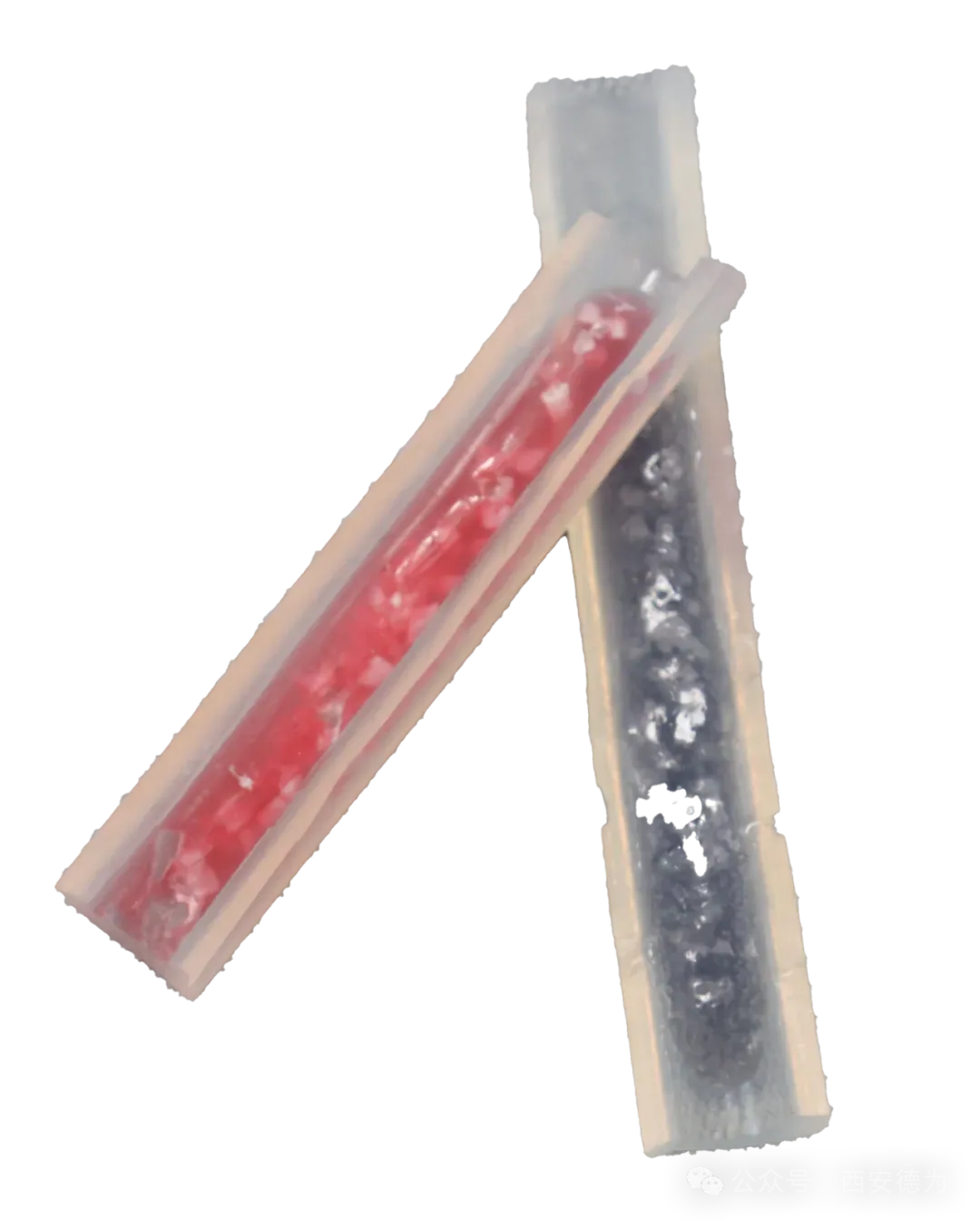
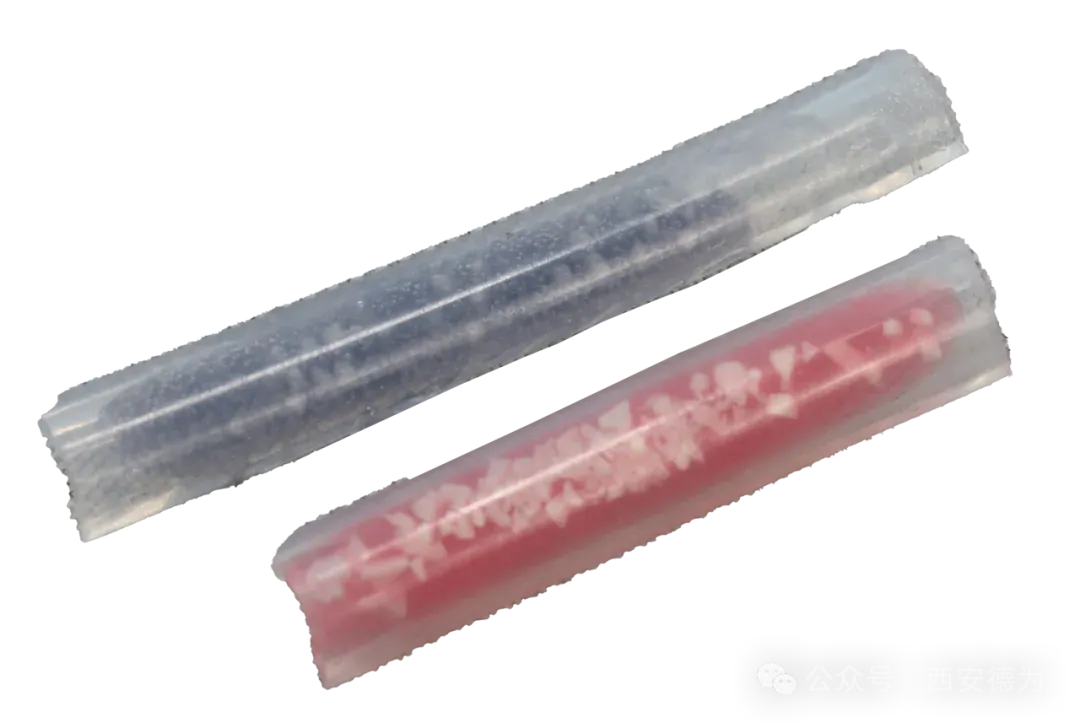
Facing this industry challenge, DeWei Medical’s engineering team collaborated closely to conduct a detailed microstructural analysis of over 200 real plaque samples. Leveraging biomimetic materials and advanced 3D printing technology, they iterated repeatedly before ultimately pioneering a "three-layer heterogeneous material composite process." This breakthrough significantly reduced the error rate in mimicking the mechanical properties of plaque components—specifically the calcified regions, lipid cores, and fibrous caps—thereby minimizing discrepancies between the model and actual tissue mechanics. The innovative approach now allows the platform to accommodate diverse plaque types, including calcified, lipid-rich, and thrombotic lesions. Additionally, the team developed interchangeable plaque components, enabling a single model to replicate up to 12 distinct lesion morphologies. This not only enhances testing efficiency and cuts down R&D costs but also improves the correlation between in vitro experimental results and clinical data, marking a major technological advancement.
When the carotid plaque treatment device jointly developed by Xuanwu Hospital and Medtronic faced challenges in clinical validation, Derui Medical stepped in as a trusted partner, offering its commitment to… Minimally Invasive Intervention Simulation Test Plan "Driven by an unwavering pursuit of excellence, we’ve delivered a breakthrough solution that sets a new industry benchmark—China’s first high-precision carotid plaque biomimetic model. This innovative product not only serves as the cornerstone for our marketing efforts but also redefines the reliability standards for in vitro experimentation."
Keywords:
Minimally Invasive Intervention,Atherosclerosis
Request a quote
*Please keep your phone accessible—we'll reach out to you within 24 hours.
PARTNERSHIP
Partnership

Contact us
Address: Wangzuo Qujiang, 3269 Yanxiang Road, Yanta District, Xi'an City
Pre-sales Consultation
Request a quote


