


2026年初医疗器械上市热潮来袭,德为医疗仿真模型助力研发加速落地
Release date:
2026-02-10 11:40
As 2026 begins, China’s medical-device industry has enjoyed a strong start to the year, with a flurry of approvals for Class III innovative devices and continued expansion of the innovative-device approval pathway. Driven by both favorable policy measures and technological breakthroughs, domestically produced medical devices are accelerating their penetration into the high-end segment and seizing early market opportunities. For R&D engineers at medical-device companies, closely monitoring industry launch trends, precisely aligning R&D priorities, and leveraging efficient R&D and testing tools to boost productivity and reduce costs have become critical enablers for expediting compliant product launches. In this context, DeWei Medical’s long-standing expertise in medical-simulation modeling is emerging as a pivotal bridge between R&D and commercialization, providing robust support for the R&D and testing of various interventional and imaging devices.
Looking back at January and February 2026, the medical device market saw a flurry of notable developments, with several blockbuster products being launched one after another, spanning key therapeutic areas such as cardiovascular, neurointerventional, and high-end imaging. These milestones have provided R&D engineers with a clear industry benchmark. In the cardiovascular field, Single-use Intracardiac Ultrasound Catheter for Minimally Invasive Electrophysiology Approved for Market Launch This Class III innovative medical device integrates magnetic navigation and ultrasound imaging, providing a more precise solution for cardiac electrophysiology procedure guidance; it is also the third Class III innovative medical device approved in Shanghai as of 2026. MicroThera’s Self-Expanding Intracranial Aneurysm Coil With simultaneous clinical implementation, the ultra-fine nitinol wire braiding technology is specifically tailored for small to medium-sized, wide-necked, unruptured intracranial bifurcation aneurysms, significantly enhancing the safety and precision of endovascular treatment and providing a new technical reference direction for the development of neurointerventional devices.


The high-end imaging sector is also witnessing breakthroughs, United Imaging Healthcare’s dual-source, dual-wide-detector CT Having successfully obtained approval, this product—the first of its kind in China—combines high temporal resolution with broad volumetric coverage, with a particular emphasis on enhancing coronary imaging capabilities. It further advances the localization and domestic substitution of high-end medical imaging equipment and opens up new application scenarios for the R&D of related ancillary products. In addition to the approved products, policy support has provided strong impetus for market access: in February 2026, a total of 10 medical device products were granted entry into the innovative “green channel,” including transcatheter artificial tricuspid valve prostheses and software for auxiliary assessment of chronic obstructive pulmonary disease, covering multiple therapeutic areas such as cardiovascular, respiratory, and digital health. By streamlining approval procedures and improving review efficiency, this initiative accelerates the clinical translation and market launch of innovative products, thereby enhancing both speed and effectiveness.

Of particular interest to R&D engineers are these approved products and the innovative medical devices that have been granted expedited review access. All of this is inseparable from rigorous, comprehensive preclinical research and development testing. —In contrast, traditional R&D approaches are characterized by high costs and lengthy timelines for animal testing, as well as test biases arising from species differences, making it difficult to meet the current demands for rapid device iteration and precision-driven development. Under these circumstances, the value of medical simulation models becomes increasingly apparent, and As a provider of minimally invasive interventional simulation testing solutions, DeWei Medical has developed high-fidelity simulation models that precisely meet the R&D and testing needs of various interventional and imaging devices. These models help R&D engineers overcome technical challenges, shorten development cycles, and accelerate the compliant launch of products.
DeWei Medical’s medical simulation models, with their core advantages of high-fidelity realism, comprehensive scenario coverage, and customizable adaptability, have become the tool of choice for R&D teams at numerous medical device companies. Their role in accelerating the market launch of medical devices is vividly demonstrated in key application areas such as neurointervention and cardiovascular medicine. In the field of neurointervention, DeWei Medical’s neurointerventional vascular model, paired with an intelligent blood-flow simulation platform, has played a pivotal role in supporting Zhongtian Medical’s development and performance optimization of its braided microguidewire, “TianZhi™,” and its all-scenario thrombus aspiration catheter, “TianJiao™.” The model is equipped with two cardiac pulsation pumps and a fluid-control tablet, enabling realistic simulation of systemic arterial and venous blood flow dynamics across all thrombectomy scenarios. This allows R&D engineers to intuitively evaluate the microguidewire’s precise torque control and long-term shape memory, as well as the thrombus aspiration catheter’s thrombectomy efficacy, providing precise data support for product optimization. As a result, both products were successfully showcased at industry trade shows and their market launch was accelerated.

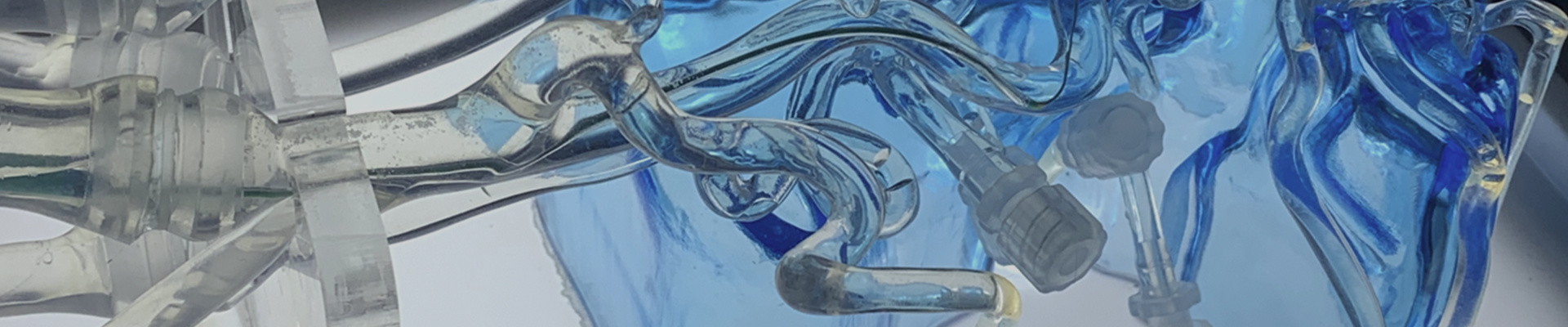
Targeting In the R&D of cardiovascular interventional devices, DeWei Medical’s cardiac electrophysiology models and coronary CTO antegrade and retrograde recanalization test models, among others, have precisely addressed key R&D challenges. The cardiac electrophysiological model is based on real-world human CTA/MRI data, with 1:1, high-precision 3D reconstruction and printing using highly transparent, soft silicone material. This not only accurately replicates subtle structures such as the four cardiac chambers and pulmonary venous branches, but also simulates the elastic modulus and coefficient of friction of real human blood vessels. When paired with an intelligent blood-flow simulation platform, it allows flexible adjustment of four key parameters—flow rate, temperature, pressure, and heart rate—thereby recreating hemodynamic environments under various physiological and pathological conditions. , enabling R&D engineers to repeatedly test the performance of ablation catheters, pacemakers, and other devices, optimize device design details, and reduce preclinical testing risks. In contrast, the forward-and-reverse recanalization testing model for coronary CTO specifically addresses the limitations of traditional models in accurately simulating the complex anatomical structure and mechanical properties of human coronary vessels, thereby providing a highly realistic in vitro testing platform for the development of CTO interventional devices and effectively reducing the discrepancy between test data and clinical reality.


In addition to targeted specialized models, DeWei Medical’s simulation models also offer the advantages of full-scenario coverage and customized services, fully accommodating the personalized needs of R&D engineers. Ranging from neurovascular intervention and coronary intervention to peripheral vascular intervention, our simulated vascular models comprehensively cover a wide array of interventional scenarios. In terms of specifications, they can accommodate testing requirements for thrombectomy catheters ranging from 3F to 8F and for microguidewires with outer diameters from 0.012 to 0.018 inches across multiple gauges. Moreover, the models can simulate various pathological conditions, including vascular stenosis, thrombus formation, and aneurysms. In addition, based on patient-specific vascular imaging data provided by R&D engineers, we can custom-build tailored simulated vascular models that accurately replicate even complex bifurcation structures and unique pathological states, thereby ensuring more reliable and clinically relevant test results and helping R&D engineers refine product designs with greater precision.
In addition, DeWei Medical’s simulation models also rigorously comply with both domestic standards and FDA regulatory requirements, providing comprehensive, expert-level literature support and detailed data reports. They are perfectly aligned with the stringent new FDA QMSR requirements for medical device quality systems and testing/validation, helping R&D engineers overcome compliance-testing challenges and ensuring smooth global market access and regulatory approval for products. Previously, DeWei Medical has provided customized simulation testing systems to organizations such as Xinhanglu Medical Technology and the Fuwai Hospital of the Chinese Academy of Medical Sciences, helping to conduct ex vivo validation studies for ECMO devices and cardiac interventional instruments. The company has also delivered bio-inspired cerebral vascular phantoms and high-end hemodynamic testing equipment to the Neurointerventional Hemodynamics Research Group at Stanford University in the United States, earning widespread recognition across the industry.

Currently, the medical device industry is in a golden age of innovation and iterative advancement. Behind the surge in product launches lies a fierce competition not only in R&D capabilities but also in R&D efficiency and testing accuracy. For R&D engineers at medical device companies, staying attuned to industry launch trends and identifying the right direction for technological innovation are essential prerequisites for breaking through and gaining market traction; meanwhile, selecting efficient and precise R&D testing tools is key to shortening development cycles, reducing R&D costs, and accelerating product time-to-market. DeWei Medical has always been committed to its mission as a provider of minimally invasive interventional simulation testing solutions. Its high-fidelity, intelligent, and customized medical simulation models precisely meet the R&D and testing needs of various interventional devices, helping R&D engineers mitigate testing risks, optimize product design, and enhance R&D efficiency. This enables innovative medical devices to move more quickly from the laboratory to clinical practice, while supporting more domestically developed medical devices in achieving regulatory compliance and gaining a competitive edge in the market.
Looking ahead, as more innovative medical devices enter the R&D and commercialization pipeline, the demand for greater precision and efficiency in preclinical testing will continue to rise among R&D engineers. DeWei Medical will remain committed to advancing medical simulation technology, aligning its offerings with industry trends and R&D priorities to continuously iterate and upgrade its products. The company will launch an expanding portfolio of simulation models and testing solutions tailored to key therapeutic areas such as cardiovascular and neurointerventional procedures, as well as high-end imaging, thereby providing medical device R&D professionals with more specialized and efficient support. This will help drive high-quality development of China’s domestic medical device industry and ensure that more innovative medical technologies benefit patients.
Keywords:
3D printing,Medical devices,Electrophysiology,United Imaging Healthcare,Neurointerventional Vascular Model,Silicone vascular model,Minimally Invasive Intervention,Simulation model,Zhongtian Medical,Food and Drug Administration,Minimally Invasive Medicine,Single-use intracardiac ultrasound imaging catheter,Coronary intervention,Cardiovascular
Other news
Request a quote
*Please keep your phone accessible—we'll reach out to you within 24 hours.
PARTNERSHIP
Partnership

Contact us
Address: Wangzuo Qujiang, 3269 Yanxiang Road, Yanta District, Xi'an City
Pre-sales Consultation
Request a quote


